
Sport Quiz
-
![]()
Football Saturday
A1 Beginner
It is football day! Join Andy and his friends for a Saturday morning in the park.
-
![]()
Abby’s First Match
A2 Elementary
Abby goes to her first football match and discovers that the day is about more than the game.
-
![]()
Why Football Brings People Together
B1 Intermediate
Explore why football means more than winning, and how it connects families, friends and communities around the world.
-
![]()
A City United by Football
B2 Upper Intermediate
Discover how match day transforms a city, supports local businesses and creates a powerful sense of belonging.
-
![]()
Has Modern Football Changed Forever?
C1 Advanced
Explore how technology, social media and modern analysis are changing football, and whether the heart of the game remains the same.
-
![]()
The Beautiful Game
C2 Proficient
Explore why football still matters in a world shaped by technology, personalised entertainment and constant change.


A City United by Football
This reading activity is for B2 intermediate-level English learners.
Discover what really happens on match day.
Read the article and refer to Useful Language for explanations of key words and phrases. Then start the quiz and test your understanding. Good luck! ⚽
When Football Takes Over the City
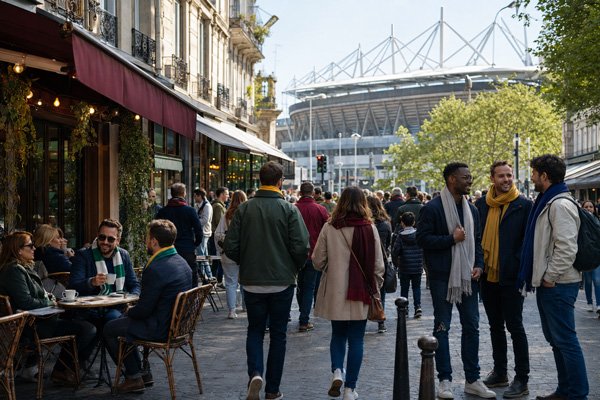
At eleven o'clock on Saturday morning, the streets around the stadium look much as they do every weekend. Local residents are shopping, buses are following their usual routes and cafés are preparing for lunchtime.
A few hours later, everything has changed.
Thousands of supporters have arrived. Trains are crowded, cafés are full and some roads have been closed to traffic. Police officers and stewards are directing people towards the stadium, while local businesses are dealing with one of their busiest periods of the week.
For ninety minutes of football, an entire part of the city has had to change the way it works.
For many local businesses, that change is welcome. A café that is normally quiet on a Saturday afternoon might suddenly have customers waiting for tables. Pubs and restaurants can serve hundreds of additional visitors, while hotels may benefit from supporters who have travelled from another city or country.
For some businesses, match day can provide a significant boost to the local economy.
But not everyone benefits.
People who live close to a large stadium may have a very different experience. Roads can become congested, buses may be delayed and finding somewhere to park can become difficult. Noise continues long after the match has finished, particularly when supporters are celebrating a major victory.
There is also the question of who pays for managing the crowds. Large matches may require additional police officers, transport staff, cleaners and security measures. Football clubs contribute to some of these costs, but the exact arrangements vary. This can lead to a wider debate about whether cities should spend public money supporting events that are organised by wealthy professional clubs.
Transport presents another challenge. Tens of thousands of people may arrive within a relatively short period, and most of them want to leave at almost the same time. Railway stations that cope easily during an ordinary afternoon can suddenly become extremely crowded.
Cities therefore have to plan ahead. Transport operators may provide additional services, roads around stadiums can be temporarily closed and supporters may be directed towards particular stations or routes. The aim is not simply to move people quickly, but to do so safely.
Then there is the atmosphere itself.
For supporters, a busy match day can make a city feel exciting. Streets fill with colour and noise, visitors spend money and areas around stadiums become places where people meet before and after the game. Even someone who has no interest in football can notice that something unusual is happening.
For other residents, however, the same atmosphere can feel like disruption rather than excitement. Their neighbourhood has temporarily been transformed for an event they may not even follow.
By early evening, the process begins to reverse. Supporters head towards railway stations, restaurant tables empty and roads gradually reopen. Cleaners remove rubbish from the streets and residents return to their normal routines.
Within a few hours, much of the evidence has disappeared.
So is hosting a major football match good for a city?
There is no simple answer. Matches can generate income, attract visitors and create an atmosphere that many people value. At the same time, they put pressure on transport, public services and the people who live nearby.
Perhaps the more interesting question is not whether football is good or bad for a city, but how cities can strike a balance between welcoming thousands of supporters and protecting the everyday lives of the people who live there.
Useful Language
boost to the local economy
An increase in economic activity or money spent in a particular area.
congested
So crowded with traffic or people that movement becomes difficult.
public money
Money collected and spent by government or public authorities.
plan ahead
To prepare in advance for something that is going to happen.
disruption
A situation that interrupts normal activities or prevents them from continuing as usual.
normal routine
The usual way in which someone does things.
generate income
To produce or create money.
put pressure on
To create additional demands or difficulties for someone or something.
public services
Services provided for the public, such as transport, policing or cleaning.
strike a balance
To find a reasonable position between two different or competing needs.